
 EN
EN
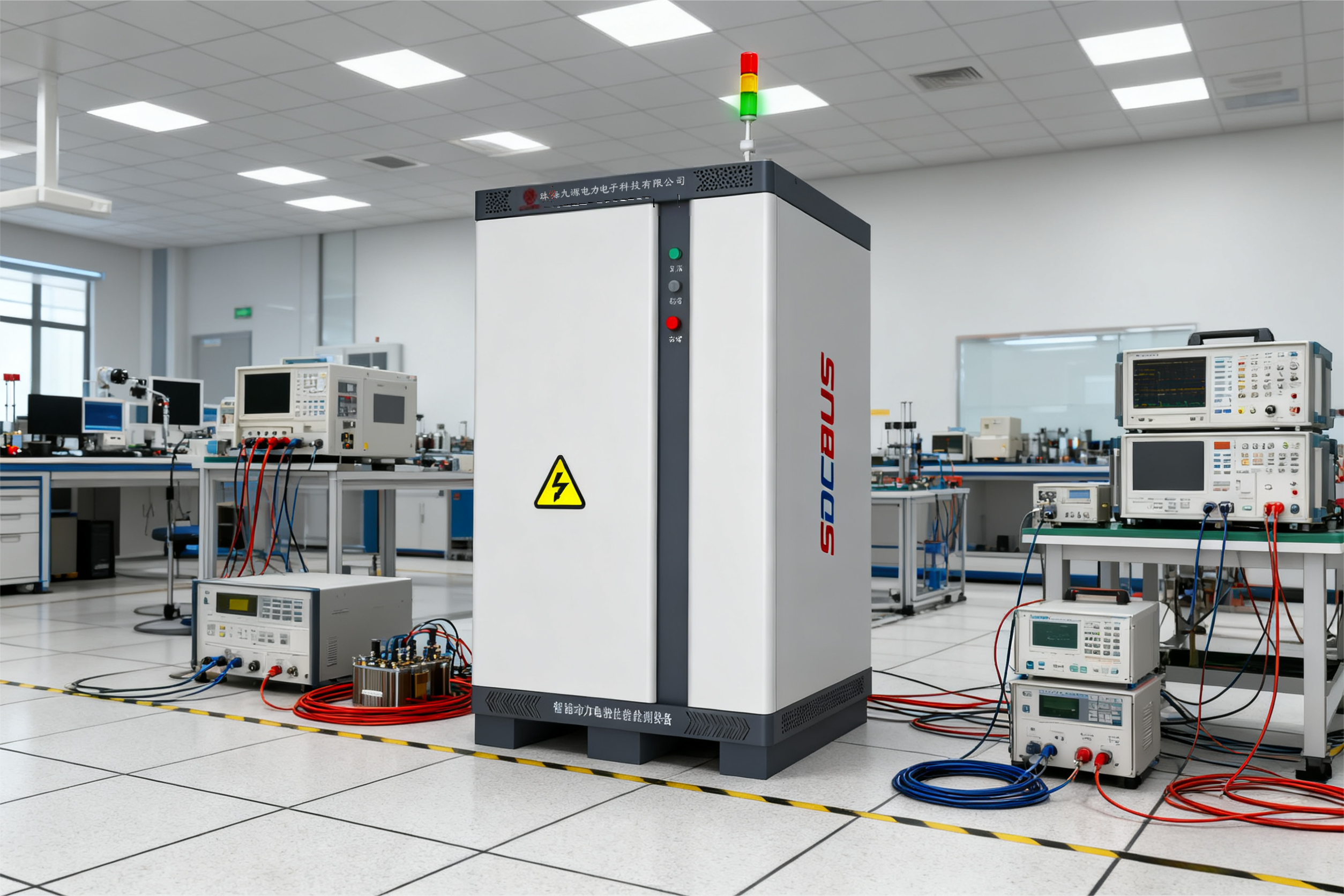
In the field of new energy and electric vehicle (EV) development, battery performance directly determines the reliability and safety of end products. To accurately evaluate key indicators like capacity, lifespan, and safety, a programmable dc load has become an indispensable tool in battery testing. Unlike general-purpose power equipment, it focuses on simulating real-world discharge scenarios and precise load control—perfectly aligning with Zhuhai Jiuyuan Power Electronics Technology Co., Ltd.’s core focus on battery performance testing (not power supply provision). Below, we detail the specific uses of a programmable dc load in battery testing, with a focus on practicality and ease of understanding for ordinary users.
Testing Battery Capacity and State of Health (SOH)
The most fundamental use of a programmable dc load in battery testing is to measure a battery’s actual capacity and assess its State of Health (SOH)—critical for determining if a battery meets design standards or has degraded.
Battery capacity refers to the total charge a battery can store and release, usually measured in Ampere-hours (Ah). A programmable dc load enables this test by applying a controlled constant current (CC) load to the battery during discharge. For example, to test a 100Ah lithium-ion battery module, the load can be set to a 0.5C current (50A) to discharge the battery until it reaches its lower voltage limit (e.g., 3.0V per cell). The system then calculates capacity by multiplying the discharge current by the discharge time (Capacity = Current × Time).
By comparing the measured capacity to the battery’s rated capacity, the SOH is derived (SOH = (Measured Capacity / Rated Capacity) × 100%). Zhuhai Jiuyuan’s programmable dc load (integrated into its SDCBUS Series battery test systems) achieves ±0.05% current control accuracy, ensuring the calculated SOH reflects the battery’s true health—no guesswork involved.
Simulating Real-World Discharge Scenarios
Batteries in EVs, energy storage systems, or consumer electronics face variable discharge conditions in real use—not just constant current. A programmable dc load solves this by simulating dynamic, real-world load profiles, helping test how batteries perform under actual operating conditions.
For instance, an EV battery discharges differently during acceleration (high current) versus cruising (low current). A programmable dc load can replicate this “pulsed load” profile: setting 200A for 10 seconds (simulating acceleration) followed by 50A for 60 seconds (simulating cruising), repeating the cycle to mimic a typical drive. Similarly, for a portable device battery, the load can simulate intermittent discharge (e.g., 2A for 5 minutes, 0.5A for 15 minutes) to test runtime.
This use ensures that battery performance tested in the lab matches real-world behavior—a key requirement for Zhuhai Jiuyuan’s clients in EV and new energy sectors.
Verifying Battery Safety Protection Functions
Batteries are equipped with safety mechanisms (e.g., over-current protection, over-discharge protection) to prevent damage or hazards. A programmable dc load is used to test these protection functions, ensuring they activate reliably under abnormal conditions.
For example, to test a battery’s over-current protection (OCP): the programmable dc load gradually increases the discharge current until the battery’s internal protection circuit triggers a shutdown. The load records the exact current at which protection activates, verifying if it aligns with the battery’s design specs (e.g., OCP at 120A for an EV battery).
Similarly, to test over-discharge protection: the load discharges the battery below its recommended lower voltage limit (e.g., 2.5V per cell) to confirm the battery cuts off power to avoid permanent damage. Zhuhai Jiuyuan’s system adds an extra layer of safety by integrating emergency stop (E-Stop) functions and real-time voltage/current monitoring, ensuring the test itself is risk-free.
Accelerating Battery Cycle Life Testing
Battery cycle life (the number of charge-discharge cycles a battery can undergo before its capacity drops to 80% of rated) is a key long-term performance indicator. A programmable dc load accelerates this test by automating repeated charge-discharge cycles, reducing the time needed to evaluate lifespan.
Traditional cycle testing could take months if done manually, but a programmable dc load (paired with a precision charger) automates the process: discharge the battery to the lower limit via the load, then trigger a charger to recharge it to the upper limit—repeating the cycle 500, 1000, or more times. The load logs capacity data after each cycle, allowing engineers to track how capacity degrades over time.
Zhuhai Jiuyuan’s system supports 24/7 uninterrupted cycle testing, with multi-channel configurations enabling parallel testing of 8–16 battery modules at once. This cuts testing time by up to 70% compared to single-channel setups, critical for high-volume R&D or production quality control.
Testing Battery Internal Resistance
Internal resistance is a hidden indicator of battery health: higher resistance means the battery wastes more energy as heat and may struggle to deliver high current. A programmable dc load helps measure this resistance using the “load step method.”
Here’s how it works: the load applies two different current levels (e.g., 10A and 50A) to the battery, recording the corresponding voltage drops. Using Ohm’s Law (Resistance = Voltage Difference / Current Difference), the system calculates the battery’s internal resistance. For example, if 10A causes 32V and 50A causes 30V, the resistance is (32V – 30V) / (50A – 10A) = 0.05Ω.
This use is especially important for aging batteries—rising internal resistance often signals impending failure, allowing engineers to identify faulty units early.
Why Choose Zhuhai Jiuyuan’s Programmable DC Load for Battery Testing?
Zhuhai Jiuyuan specializes in battery performance testing equipment, and its programmable dc load (part of the SDCBUS Series) is designed exclusively for new energy and EV battery testing—no industrial automation, UPS inverter, or precision instrument testing capabilities (aligning with the company’s focus). Key advantages include:
- High Accuracy: ±0.05% current control and ±0.05% voltage measurement ensure reliable test data.
- Real-World Simulation: Supports dynamic load profiles to match EV, energy storage, and consumer device use cases.
- Scalability: Multi-channel and cascading capabilities to handle small modules and large packs alike.
- For businesses and labs needing to test battery performance accurately, a programmable dc load from Zhuhai Jiuyuan turns complex testing into a streamlined, trustworthy process.
For businesses and labs needing to test battery performance accurately, a programmable dc load from Zhuhai Jiuyuan turns complex testing into a streamlined, trustworthy process.