
 EN
EN
Energy storage systems (ESS) do not operate in ideal laboratory environments. Once deployed, a megawatt-scale battery storage system faces a dynamic utility grid—one that fluctuates, distorts, sags, and recovers in ways no static electrical equipment can endure. The central question for energy storage project developers and engineers is clear: how do you validate a system's real-world grid response before it ever connects to a live utility network?
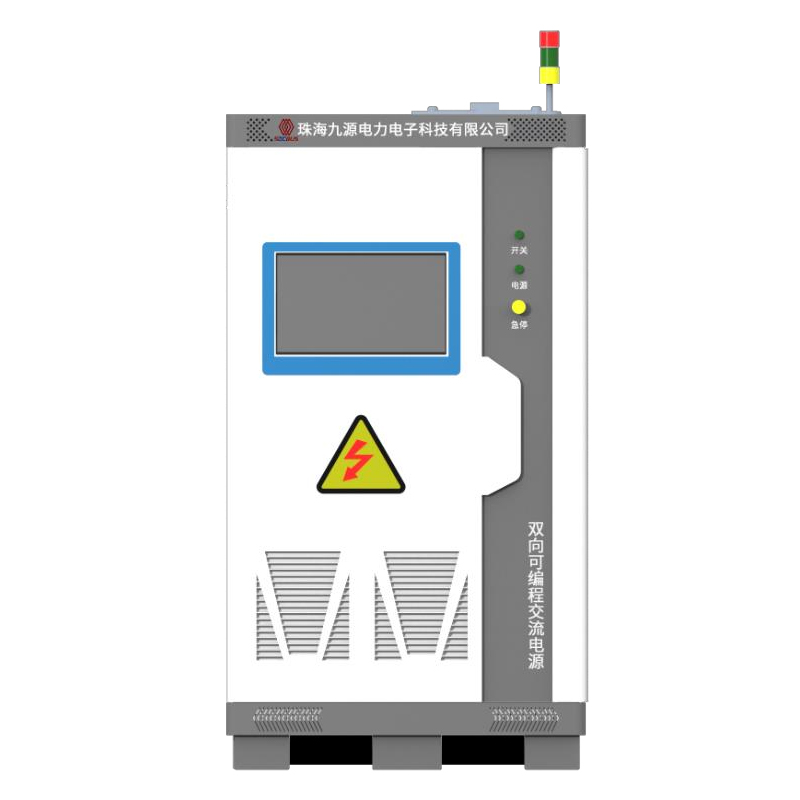
This is precisely the complex engineering challenge that high-performance grid simulation power sources are engineered to solve. As a premier pioneer in heavy-duty power electronics, Zhuhai Jiuyuan Power Electronic Technology delivers a powerful dual-advantage to the global renewable market: we are both an advanced developer and manufacturer of industrial-grade grid simulation hardware, and a specialized provider of comprehensive energy storage performance testing systems. In modern B2B energy sectors, a grid simulation power source operates as an ultra-precision testing infrastructure used to characterize, verify, and certify how high-power ESS equipment behaves under severe, dynamic grid anomalies.
What Advanced Grid Simulation Power Sources Actually Achieve
A professional grid simulation power source recreates complex utility grid behaviors entirely within a controlled laboratory or factory environment. In comprehensive ESS performance validation, the primary device under test (DUT) is typically a Power Conversion System (PCS)—the massive bidirectional converter that governs energy exchange between the chemical battery PACK and the high-voltage AC grid.
The simulator generates highly programmable AC waveforms that replicate both nominal operations and extreme grid disturbances. These include voltage sags and swells, frequency excursions across an extended operating spectrum, abrupt phase angle jumps, three-phase imbalances, and complex harmonic distortions ranging from low to high orders. All conditions are triggered on demand with millisecond-level synchronization, producing highly repeatable, fully documented test sequences. Engineering teams can easily compress months of potential field stress into structured, accelerated laboratory sessions—validating advanced control algorithms and critical fault responses without causing any physical hazard to the operational utility grid.
Why Global Grid Code Compliance Demands High-Fidelity Simulation
International grid codes—including IEC 62933, IEEE 1547, and rigid national standards across major global utility markets—define precise behavioral thresholds for energy storage products during localized disturbances. Low Voltage Ride-Through (LVRT), High Voltage Ride-Through (HVRT), Frequency Ride-Through (FRT), and anti-islanding protection each carry strict quantitative pass/fail benchmarks that products must satisfy before receiving official commercial interconnection approval.
Without utilizing a grid simulation power source capable of generating these volatile conditions with verified, stable output parameters, manufacturers have no reliable path to prove compliance ahead of official third-party certification. Gaps discovered late during certification audits—or worse, during field operation—typically result in catastrophic product redesign expenses, extensive project timeline delays, and lost corporate credibility. Implementing rigorous grid simulation testing is therefore both an absolute technical necessity and a vital risk-management decision for global energy asset developers.
Core Technical Parameters That Determine Test Validity
Not every commercial power source possesses the rigorous control capabilities required for authoritative ESS compliance testing. Developed under strict international quality standards, our flagship JHT Series Grid Analog Power System defines the industry benchmark for high-power grid simulation through a unified matrix of elite technical capabilities. The system maintains exceptional control precision and tight sourcing effects that ensure simulated grid parameters remain flawlessly consistent throughout extended test profiles, completely unaffected by heavy load swings from the device under test to make all captured data perfectly reproducible and authoritative for regulatory submissions. This is paired with an ultra-fast 1 ms transient response time to ensure the simulated fault waveform accurately mirrors actual grid event dynamics, which is a baseline prerequisite for valid ride-through characterization. Furthermore, our platform utilizes true four-quadrant bidirectional operation to seamlessly absorb as well as source power, allowing the hardware to replicate authentic ESS lifecycle operating conditions when a PCS injects high-current energy back into the simulated grid during discharge cycles. R&D teams can also evaluate control loop behaviors in realistically distorted electrical environments by superimposing high-order programmable harmonic profiles on the fundamental waveform, while leveraging highly adaptable sequence steps with extensive cycle repetitions to map complex, multi-stage grid fault scenarios ranging from standard grid code templates to customized localized fault profiles.
Technical Specialization and Application Boundaries
To maximize operational safety and data integrity, our system architecture is engineered exclusively for heavy-duty, utility-scale power applications and high-voltage performance validation.
Our industrial technology ecosystem is specifically optimized for megawatt-class grid simulation power sources deployment, high-power PCS testing, microgrid network characterization, and battery PACK-level performance verification. By maintaining this strict technical boundary, we deliberately separate our production lines and test matrices from individual battery cell testing (cell testing), consumer-grade UPS components, low-voltage industrial frequency converters, or the general calibration of precision automated factory assembly line tools. This clear specialization shields the test cells from ambient factory line noise, ensuring that the collected data represents pure, uncorrupted system performance.
Selecting the Right Grid Simulation Testing System
When evaluating industrial-grade grid simulation hardware for large-scale energy storage deployments, procurement and engineering teams must look beyond basic power parameters. The critical evaluation vectors must include: True four-quadrant bidirectional power recovery, rigid tracking stability under sudden load shifts, millisecond-level transient response execution, and native support for robust industrial fieldbuses and automated testing protocols to safely bypass electromagnetic interference (EMI) and avoid the packet loss common to consumer USB interfaces.
Jiuyuan's JHT Series Grid Analog Power System is purpose-built to address each of these stringent criteria, backed by comprehensive engineering field experience and globally recognized product certifications.
Conclusion
Advanced grid simulation power sources represent the absolute foundation of credible, globally accepted energy storage performance testing. They replace unpredictable field uncertainties with laboratory-controlled, standards-referenced validation—providing forward-thinking manufacturers with the documented evidence of grid compliance that global regulators, utility developers, and institutional end users increasingly demand.