
 EN
EN
Executive Summary and Fundamental Operating Principle
In high-power energy storage performance verification, battery pack validation, and Power Conversion System (PCS) testing facilities, conventional single-directional power source equipment often struggles to meet dynamic testing demands. During heavy-duty cycling tests, discharging energy storage systems generate substantial electrical energy that must be absorbed safely and effectively. This operational reality raises a common question among testing facility engineers and lab directors: What is a bidirectional AC power supply, and how does it optimize high-power testing infrastructure?
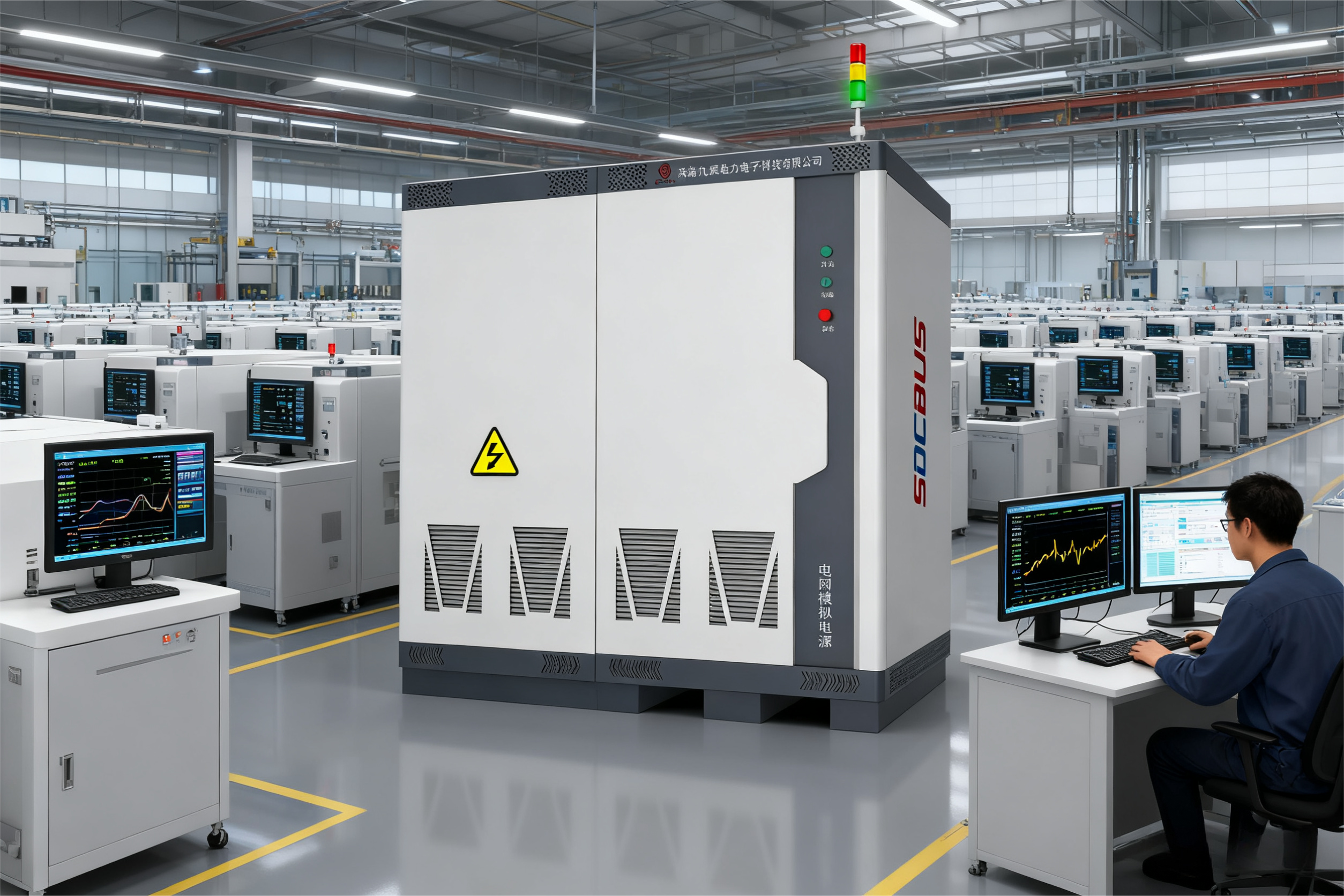
A bidirectional AC power supply is an advanced testing system designed to source and sink alternating current (AC) power within a single modular platform. Unlike standard power sources that can only deliver energy to a Unit Under Test (UUT), a bidirectional AC power unit functions seamlessly as both a programmable AC grid simulator and a high-efficiency regenerative load. In this guide, we explain its core operating mechanics, technical advantages, and key economic benefits for power testing labs.
Core Working Mechanisms of Regenerative AC Power Systems
To understand how a bidirectional AC power supply functions during rigorous performance evaluations, it is essential to look closely at its underlying power topology. In a standard test setup for energy storage packs or PCS units, electrical power must flow dynamically in both directions—simulating both power consumption during charging and energy generation during grid-feed or discharge modes.
Advanced testing architectures employ dual active bridge topologies and active front-end (AFE) converters with high-frequency switching semiconductors. When acting as a power source, the system converts facility AC input into clean, highly regulated AC output to feed the UUT. Conversely, when the UUT generates power (such as a PCS discharging into the simulated grid), the bidirectional unit acts as a regenerative electronic load. It absorbs the excess power, converts it back into synchronised AC power, and feeds it directly into the local facility grid with an energy recovery efficiency of up to 90%. This eliminates the need for massive resistive heat banks and significantly lowers thermal management costs.
Evaluating Power Precision and Dynamic Voltage Modulation
Executing publication-grade performance testing on energy storage modules, battery packs, and grid-tied converters requires uncompromised electrical accuracy and fast dynamic response. When evaluating a bidirectional AC power supply, testing engineers must assess its voltage regulation, current control, and harmonic distortion under rapid load transitions.
For high-precision performance verification labs, advanced testing channels achieve tight output voltage accuracy and output current accuracy of ±0.05% F.S. (Full Scale). This ±0.05% F.S. precision ensures that microvolt-level transient drops, phase angle shifts, and dynamic pulse responses are recorded accurately without baseline sensor drift. Furthermore, maintaining Total Harmonic Distortion (THD) below 1% ensures that any observed power quality issues stem strictly from the UUT rather than the test equipment itself, satisfying international compliance standards like IEEE 1547 and UL 1741.
Lab Automation, Driver Integration, and EMI Resilience
Operating high-power bidirectional test channels within automated testing software requires dependable, noise-resistant control links. High-power switching hardware generates electromagnetic noise that can disrupt unshielded control cables.
To ensure stable data transmission, bidirectional AC power systems support established industrial communication protocols, including CAN bus, Modbus TCP/RTU, RS485, RS232, and multi-cabinet Daisy-Chain topologies. Providing open SDKs and driver packages for LabVIEW, MATLAB, or custom SCADA suites allows software developers to integrate the power unit smoothly into full-lab automation sequences without complex custom driver development.
Key Operational Benefits and Economic ROI for Test Laboratories
Deploying a bidirectional AC power supply in a performance testing facility offers far-reaching advantages beyond basic functional simulation. By combining source and load functions into a single modular chassis, labs reduce equipment footprint and streamline testing workflows.
The primary economic driver is energy regeneration. Recycling up to 90% of discharged electrical power back into the internal facility grid reduces overall facility utility consumption drastically during long-duration cycling tests. Furthermore, eliminating large resistive load banks minimizes heat generation in the lab, decreasing HVAC cooling infrastructure demands and lowering both operational expenditure (OPEX) and capital expenditure (CAPEX). Coupled with multi-layer hardware protection—including over-voltage, over-current, and Emergency Stop (E-Stop) safety loops—these systems ensure safe, cost-effective, and future-proof testing operations.
Conclusion and Strategic Takeaways
In summary, a bidirectional AC power supply is a vital testing system that sources and sinks AC power seamlessly, serving as both a clean grid simulator and a regenerative energy load. By leveraging high voltage/current precision of ±0.05% F.S., up to 90% energy regeneration efficiency, and robust industrial communication (CAN, Modbus, Daisy-Chain), performance testing facilities can validate battery packs, modules, and PCS units with total confidence. Partnering with a specialized power electronics testing equipment vendor ensures your test lab maintains high accuracy, operational safety, and optimal energy efficiency.
Table of Contents
- Executive Summary and Fundamental Operating Principle
- Core Working Mechanisms of Regenerative AC Power Systems
- Evaluating Power Precision and Dynamic Voltage Modulation
- Lab Automation, Driver Integration, and EMI Resilience
- Key Operational Benefits and Economic ROI for Test Laboratories
- Conclusion and Strategic Takeaways