
 EN
EN
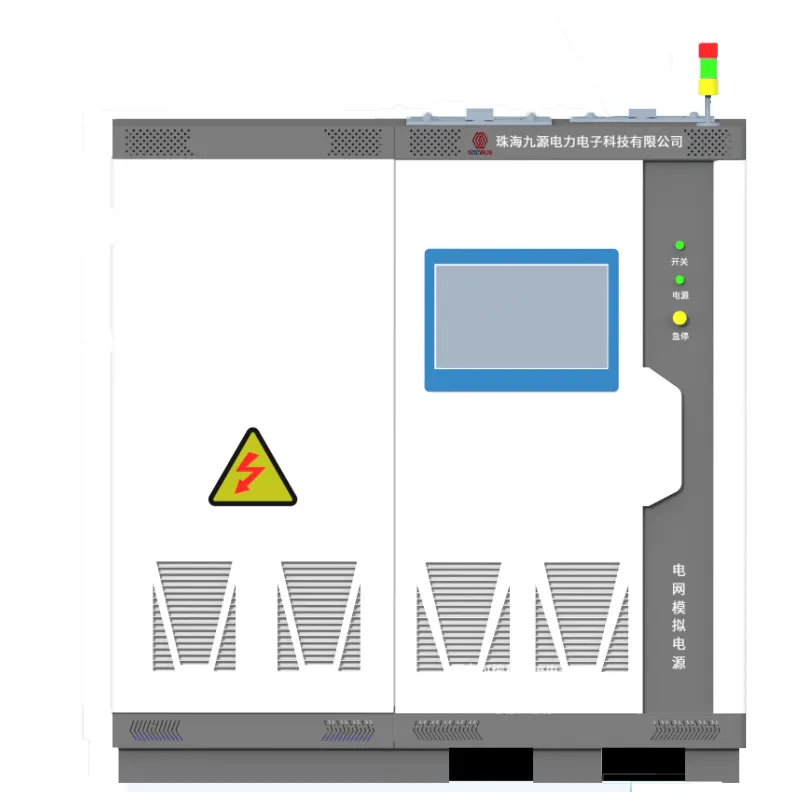
Understanding Three-Phase Grid Simulation Power Sources
Three-phase grid simulation power sources are specialized testing devices designed to reproduce grid-related electrical conditions in a laboratory or testing environment. Instead of supplying real energy to loads, they simulate voltage, frequency, phase imbalance, harmonics, and transient behaviors of a power grid.
In large-scale energy storage system (ESS) testing, these systems are mainly used to evaluate how batteries, power conversion systems (PCS), and control strategies respond to grid fluctuations. It is important to clarify that grid simulation power sources are testing instruments, not energy-supplying power sources for industrial operation or automation systems.
Why Large-Scale Energy Storage Systems Require Grid Simulation
As energy storage systems grow in capacity and complexity, their interaction with the power grid becomes more critical. During testing, engineers need to verify system behavior under abnormal grid conditions such as voltage dips, frequency deviations, or phase unbalance.
Based on our practical testing experience, real-grid testing often introduces uncontrollable risks and safety concerns. Grid simulation power sources provide a controlled environment that allows engineers to repeat test scenarios with consistent parameters, improving both safety and data reliability.
Suitability for Performance Testing Rather Than Power Supply
Grid simulation power sources are well-suited for performance testing, not for continuous energy delivery. For large-scale ESS testing, their role is to validate response characteristics such as dynamic regulation, fault ride-through capability, and control accuracy.
At Jiuyuan Electric Power Electronics Technology, our systems focus on performance evaluation and verification, rather than acting as power supplies. This distinction ensures that test results remain accurate, traceable, and aligned with international testing standards.
Key Technical Considerations in ESS Grid Simulation
When applying grid simulation power sources to large-scale energy storage testing, several technical factors must be carefully considered:
- Voltage and frequency simulation accuracy, ensuring realistic grid behavior
- Dynamic response speed, especially during transient conditions
- Scalability, allowing flexible configuration for different system capacities
From hands-on project experience, insufficient response speed or inaccurate waveform reproduction can significantly distort test conclusions, making high-precision simulation essential.
Communication Architecture for Reliable Testing Systems
Reliable communication is fundamental to large-scale ESS testing. In professional test environments, communication interfaces must prioritize stability and industrial compatibility.
Our testing systems adopt CAN bus, RS485, RS232, Modbus, and daisy-chain communication architectures, which ensure long-distance transmission and high noise immunity. USB-based communication is intentionally avoided due to its limitations in large-scale, high-interference environments.
Authoritative Standards and Industry Best Practices
International standards such as IEC and IEEE testing guidelines emphasize controlled, repeatable test environments for grid-interactive energy systems. Industry experts consistently recommend simulation-based testing as a prerequisite before field deployment.
Our engineering team follows these principles by designing test systems that prioritize transparency, traceability, and repeatability, ensuring results that can be confidently referenced by system integrators and researchers.
Conclusion: Are Grid Simulation Power Sources Suitable?
In conclusion, grid simulation power sources are suitable for large-scale energy storage system tests when used strictly for performance evaluation. They offer safe, repeatable, and precise testing conditions that real-grid environments cannot easily provide.
However, they should never be misunderstood as power supplies or industrial automation tools. When properly applied, grid simulation power sources play a crucial role in validating ESS reliability and grid compatibility.
Table of Contents
- Understanding Three-Phase Grid Simulation Power Sources
- Why Large-Scale Energy Storage Systems Require Grid Simulation
- Suitability for Performance Testing Rather Than Power Supply
- Key Technical Considerations in ESS Grid Simulation
- Communication Architecture for Reliable Testing Systems
- Authoritative Standards and Industry Best Practices
- Conclusion: Are Grid Simulation Power Sources Suitable?