
 EN
EN
For battery R&D engineers, test engineers, and equipment procurement teams
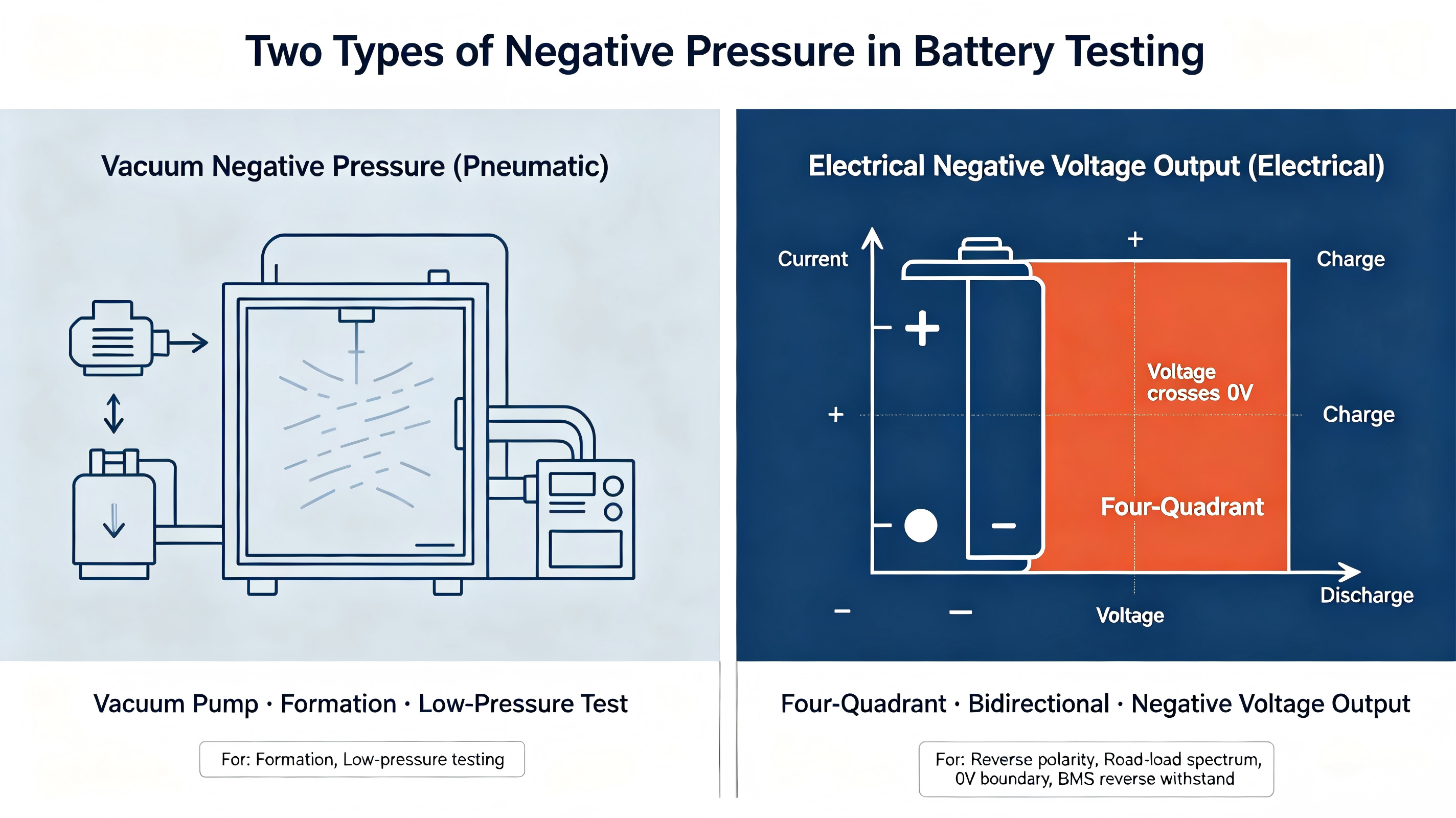
Summary: In battery equipment discussions, customers often ask for "negative pressure" capability. But "negative pressure" refers to two completely different concepts: vacuum negative pressure (pneumatic) and negative voltage output (electrical). Many projects end up with the wrong equipment because these two concepts get mixed up. This article clarifies the difference, explains the operating conditions, and helps you decide whether your test really needs negative voltage output.
When specifying a battery test system, "negative pressure" is one of the most common verbal requirements. The same phrase can refer to two completely different hardware functions. If the requirement is misunderstood, the delivered system may not meet the test plan — causing project delays.
Many people also confuse negative voltage with discharge. Let's start with the key conclusion:
Negative voltage ≠ discharge. Charge and discharge describe current direction and energy flow. Positive and negative voltage describe the polarity of the voltage across the battery terminals. These are two different dimensions, and they are not necessarily linked.
Two Types of "Negative Pressure" — Don't Mix Them Up
1.1 Vacuum negative pressure (pneumatic)
This refers to ambient pressure below standard atmospheric pressure, created by a vacuum pump.
Typical equipment: battery formation equipment, low-pressure test chambers.
It is mainly used for degassing during battery formation, or for simulating low-pressure / high-altitude environments.
⚠️ Key point: A standard battery charge/discharge test system does not include vacuum pumping. If you need a vacuum environment for battery testing, you need a separate vacuum test chamber. This is not an electrical function of the battery test system itself.
1.2 Electrical negative voltage output (what customers usually mean by "negative pressure")
This means the test system's output voltage can cross 0V and be controlled in the negative voltage range. It is a four-quadrant, bidirectional test capability.
In simple terms: for a normal battery, the positive terminal is at a higher potential than the negative terminal, so the voltage is positive. Under reverse-polarity conditions, the positive terminal potential becomes lower than the negative terminal, and the voltage appears negative.
When customers say they need "negative pressure," this is usually what they mean — controllable, controllable negative voltage output, not vacuum pumping.
Why Negative Voltage Is Not the Same as Discharge
-
Charge / discharge: look at current direction. When a battery releases energy, current flows out of the positive terminal — that is discharge. In most standard discharge tests, the battery voltage remains positive and never enters the negative voltage range.
-
Positive / negative voltage: look at terminal polarity. This only describes the potential relationship between the two terminals. It has nothing to do with the direction of energy flow.
The table below shows four typical operating conditions and the four-quadrant logic behind them:
| Condition | Voltage state | Current direction | Description |
|---|---|---|---|
| Normal charge | Positive voltage |
Charge current flows into positive terminal |
Standard charge /discharge cycling |
| Normal discharge | Positive voltage |
Discharge current flows out of positive terminal |
Capacity and cycle life testing |
| Reverse-polarity charge | Negative voltage | Current flows into positive terminal |
One cell in a series string is over-discharged and reverse-charged by the other cells |
| Reverse-polarity discharge | Negative voltage | Current flows out of positive terminal | Rare extreme cell failure condition |
Important note: When negative voltage appears, the battery is very likely in a reverse-charging state, not discharging. Do not assume "negative pressure" means "discharge." Under reverse polarity, the terminal voltage is negative, but the current direction depends on the external circuit and must be evaluated case by case.
Which Test Scenarios Actually Require Negative Voltage Output?
Not every battery test needs negative voltage. Standard capacity tests, normal charge/discharge cycling, and rate tests keep the voltage in the positive range and do not require negative voltage.
The following R&D validation scenarios do require controllable negative voltage output:
-
Cell reverse-polarity and over-discharge fault simulation
In a multi-cell string, an over-discharged cell can be reverse-charged by the other cells, producing a reverse-polarity negative voltage. Negative voltage output reproduces this fault, evaluates cell failure behavior, and verifies whether the BMS and protection board logic is reliable. -
Real-world road-load spectrum simulation
During vehicle operation or energy storage converter switching, transient energy backflow can occur, producing reverse voltage surges. The test system must switch seamlessly between positive and negative voltage at high speed to reproduce real operating conditions. -
0V boundary characterization
For power batteries and energy storage cells, studying performance at 0V and beyond the zero-potential point supports deep over-discharge and safety boundary exploration. -
BMS and protection board reverse withstand voltage validation
Simulating reverse connection and system energy backflow faults verifies the ability of the BMS and protection devices to withstand reverse voltage surges.
How to Tell Whether a System Really Supports Negative Voltage Output
Four points for test engineers and procurement teams:
-
Clarify the concept first. When a customer says "negative pressure," confirm whether they mean vacuum negative pressure or electrical negative voltage output. This avoids misunderstandings early.
-
Distinguish "measuring negative voltage" from "outputting negative voltage." Some systems can only measure negative voltage passively. They cannot actively output a controlled negative voltage, so they cannot perform fault simulation or road-load spectrum testing. Always confirm the system can output negative voltage.
-
Confirm the negative voltage range. Do not stop at "supports 0V." 0V charging and negative voltage output are two different things. Confirm the specific voltage and current range in the negative region, and whether bidirectional energy flow is supported.
-
Confirm protection capability. Negative voltage testing is a boundary and hazardous condition. Do not replace a professional battery test system with a modified unidirectional power supply. Without hardware-level protection, this can cause cell fire or equipment damage.
If your work only involves standard capacity, cycle, and rate testing, and the voltage always stays positive, you do not need negative voltage capability.
Negative Voltage Capability Can Be Configured Per Project Requirements
Zhuhai Jiuyuan battery test systems support four-quadrant bidirectional output. The negative voltage range can be configured according to project requirements. Please consult our technical engineers for specific ranges. We can provide negative voltage testing capability for applications ranging from low-voltage small cells to high-voltage large battery packs.
Typical application tiers:
| Tier | Typical test object | Channel configuration |
|---|---|---|
| Low voltage | Small cells, modules | Multi-channel, suitable for batch cell testing |
| Medium voltage | Modules, medium-voltage packs | Multi-channel, supports high-current ranges |
| High voltage | High-voltage battery packs | Fewer channels, high power, supports high-voltage conditions |
The table above is a typical application tier illustration. Specific voltage, current, power, and channel count can be configured per project requirements. Please consult our technical engineers for detailed ranges.
Core capabilities under negative voltage conditions:
-
Wide voltage coverage
Voltage range is configurable per project requirements, covering low, medium, and high voltage tiers. -
High precision across the full range
Voltage and current accuracy ±0.02% F.S., voltage resolution ≤0.1mV, current resolution ≤0.1mA. High-precision output and measurement are maintained in the negative voltage region — accuracy does not degrade below 0V. -
Fast dynamic response
Current response time 5ms (10%–90%), charge/discharge switching time ≤5ms (-90%–90%, battery loaded, no overshoot). Supports 20ms road-load spectrum testing to capture millisecond-level transient reverse voltage changes. -
Energy regeneration
Power factor ≥0.99 with energy feedback capability. Energy generated during reverse-condition testing can be fed back to the grid, reducing test energy consumption. -
Comprehensive hardware protection
Integrated battery protection, output line disconnection protection, overvoltage, undervoltage, overcurrent, overload, over-temperature, surge protection, anti-islanding, lightning protection, self-diagnosis, and hardware over-temperature protection. Supports breakpoint resume and emergency stop. Negative voltage testing is a boundary and hazardous condition — hardware-level protection safeguards the sample, the equipment, and personnel. -
Software fully adapted to negative voltage conditions
Supports multi-channel aggregate display and batch operation, chamber linkage control, operating condition data comparison, and custom expression calculations. Negative voltage data is fully logged and can be exported to Excel templates for failure analysis.
Conclusion
As battery safety requirements continue to rise, boundary conditions such as reverse polarity and reverse voltage surges have become mandatory validation items in many projects. Controllable negative voltage output is a key capability of high-end battery test systems.
Zhuhai Jiuyuan battery test systems support configurable negative voltage ranges per project requirements, balancing precision, response speed, and safety protection for cell, module, and pack R&D validation.
If you need to evaluate whether your project requires negative voltage capability, or to confirm the negative voltage range and channel configuration, please contact our technical engineers.
Table of Contents
- Two Types of "Negative Pressure" — Don't Mix Them Up
- Why Negative Voltage Is Not the Same as Discharge
- Which Test Scenarios Actually Require Negative Voltage Output?
- How to Tell Whether a System Really Supports Negative Voltage Output
- Negative Voltage Capability Can Be Configured Per Project Requirements
- Conclusion